
I made a free, open-source tool that finds your best Lichess games
A small side project I’ve been working on over the last few weeks. It searches your Lichess games and tries to find the ones you’re most likely to remember: clean wins, big upsets, swindles, and everything in between.
Magnum Opus Chess
A tool for finding your best games on Lichess
(https://magnum-opus-chess.netlify.app/)
I wanted an easy way to look back through my Lichess games and find the games I was actually proud of. Lichess lets you sort by accuracy, but that isn’t really the same thing. A smooth positional win, a successful swindle, and a chaotic tactical slugfest can all be memorable for completely different reasons.
I started by writing a Python script to do this for my own games. After a few iterations it was finding the kinds of games I had in mind surprisingly well, so I eventually turned it into a website (with a lot of help from Claude) so anyone could use it.
You enter a Lichess username, choose either all-time or a date range, and the site searches for five different kinds of games:
- Flawless – wins where neither side blundered and you were never objectively worse.
- Highest-Rated Wins – victories against your strongest opponents.
- Biggest Upsets – wins against players rated well above you.
- Wild Rides – games where the engine evaluation swung back and forth repeatedly before you won.
- Swindles – games where you were objectively losing for a substantial part of the game but still escaped with a win (or, occasionally, a stalemate).
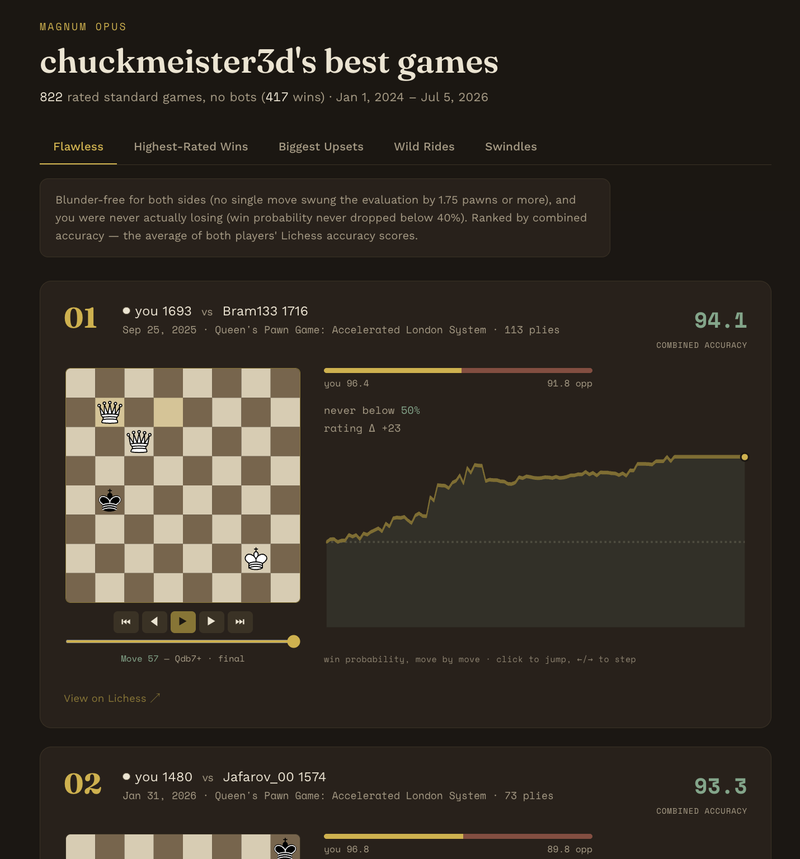
These aren’t just filters on existing Lichess statistics. Each category has its own set of rules based on engine evaluations, rating differences, blunders, and other information from the game. I spent quite a while tweaking the thresholds so that the results generally “felt right”, although there were inevitably a lot of judgement calls along the way.
The site uses existing Lichess analysis whenever it’s available. If a game hasn’t been analysed, Stockfish runs locally on your own machine instead. Before it starts, it estimates how many games need analysing and roughly how long it will take, so you can decide whether it’s worth it. Analysis is parallelised across CPU cores, which helps quite a bit if you have a large database.
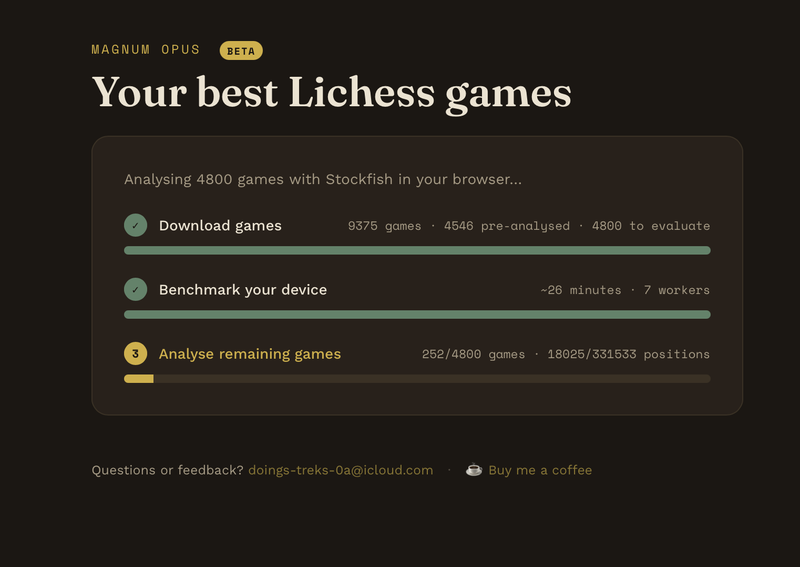
If you have lots of unanalysed games, there’s also an option to paste in a free Lichess API token. It’s completely optional, but it speeds up downloading analysed games from Lichess considerably. Nothing is uploaded anywhere beyond the requests made directly to the Lichess API.
The project is open source (GPLv3, since it bundles Stockfish and the Lichess piece set), so if you’re curious its all on Github:
https://github.com/chuckmeister3d/magnum-opus-chess
Live website:
https://magnum-opus-chess.netlify.app/
This is my first proper web project, so I’m sure there are things that could be improved. I’d especially like feedback on the five categories. If one of your games ends up somewhere that doesn’t seem quite right, or you think there’s an obvious category I’ve missed, let me know. The rules are easy enough to tweak, and I’d like them to reflect what chess players actually think makes a memorable game.
It's hard to define what a great game is so I welcome any suggestion on rules or criteria that could identify them. One suggestion from reddit is to filter by games that reach an endgame or end in checkmate. A endgame grind list could also be interesting!
I’m also curious what everyone else’s magnum opus turns out to be, so please share! (share button incoming soon)
Here's on of my top games.
You may also like
 Lichess
Lichess: End of Year Update 2025
Is it just us, or has this year flown by? As we say goodbye to 2025 and enter 2026, let's look back … ChessMonitor_Stats
Where do Grandmasters play Chess? - Lichess vs. Chess.com
This is the first large-scale analysis of Grandmaster activity across Chess.com and Lichess from 200… thibault
How I started building Lichess
I get this question sometimes. How did you decide to make a chess server? The truth is, I didn't. Fire-work