
Photo by Micah & Sammie Chaffin on Unsplash
Going for it
My previous two games in this tournament demonstrated a bit of hesitation and fear. Can I overcome that when the opportunity presents itself to gain an advantage?
In my previous two games, I was having some trouble playing confidently. I wasn't looking at or playing moves that could help create problems for my opponents. I mentioned at the end of the post that this appears to be an area that I need to work on. Did I do that between those games and this one? Absolutely not. I was traveling the entire two-week span (I took a bye for round 3 since I was away), so I didn't really have much time to put into chess beyond playing some blitz on my phone. Because of that, we'll get right into the game.
M.B. vs Mike (July 2026)
Anyone that's followed my blog so far might recognize the initials M.B. We've actually played before! If you haven't seen the game already, the short-story of it is that I went for a very early c5-Qb6 against the London, had a better position out of the opening, got my queen trapped, and eventually ended up applying a bunch of pressure on the clock to win. So when I got the pairing and saw that I would play black again, I was feeling great. I know this opponent. I know we're getting a London. I know they are not comfortable in the c5-Qb6 lines. I know that I can try to play for the clock. So that was my game plan.
1. d4 Nf6 2. Bf4 c5
Obviously going for my plan. I assumed my opponent would have looked at this c5 move after our last game since they appeared to be out of book when I played it the last time. But that didn't bother me really, I still figured I would have slightly more experience in this line and that should benefit me.
3. c3
Opponent mixing it up. They went for 3. e6 last time.
3... Qb6 4. Qb3
I think(?) this is a common idea to have the queens oppose each other like this. Maybe not in this exact position, but I've seen positions in other opponents where this happens. Maybe someone can educate me in the comments!
Either way, I was expecting this and was planning to simply develop here.
4... g6 5. dxc5!?
I didn't like this move. It seems to force my queen to a move active square. It also can loosen the diagonal for my bishop in the longer-term. And without the pawn on c3 supporting the d-pawn, it's a bit awkwardly placed and potentially restricting the knight.
I thought about what would happen on 5. Qxb6 but I thought that should be fine for me.
5... Qxc5 6. Nf3 Bg7 7. g3?
My opponent was already thinking a bit. They were definitely trying to play a bit faster, but they spent a few minutes here. Clearly they were trying to develop the bishop to g2 or h3, but unfortunately for them, it's a mistake in this position.
It was here I actually thought for about 15 minutes. Probably only 5 of those minutes were actually spent calculating. There really isn't much white can do to complicate matters after 7... Ng4, but somehow I kept hesitating.
"What if I was missing something?! Castles or d6 are also very reasonable moves. There's no reason to go for this and risk missing something on move 7." I was saying to myself. After 10 minutes of thoughts like this looping in my brain, I forced myself to just go for it.
7... Ng4
And I got up from the board to refill my water cup and chill myself out. When I returned the playing hall with my water refilled, I saw that my opponent was still thinking, so I went to look around and take a peek at the other boards, checking back in every now and again. I was probably standing and walking around for 15 or so minutes before my opponent made a move. When I sat down, I could see that they looked fairly disappointed, which was great for me. I mean, what could be better than winning on the board and clock, and also having a better mindset.
8. Be3
I was very happy to see this because it meant that my opponent also wasn't able to find any moves that would complicate matters or refute my idea.
8...Nxe3 9. fxe3 Qxe3
And we're up a pawn with a much easier position to play.
The position is kind of brutal for my opponent. I have fairly simple development, and, at least for now, their king is stuck in the center of the board.
10. Nbd2 O-O 11. Bg2 Nc6 12. Rd1 d6 13. Rf1
I was a little puzzled by this move since now White's king is have an extremely hard time leaving the center of the board. I posted some ideas in the study (you should be able to see the lines in the interactive boards) for what I thought were some better approaches for my opponent during the game that would at least get their king to safety. Feel free to check them out or provide some ideas of your own!
13...Rb8
I looked at 13... Be6 here, but decided that I didn't want to give up the pawn. It works (I didn't know that during the game obviously), but it's not necessary.
14. Nc4 Qc5 15. Ncd2 Be6 16. Qa4 b5 17. Qh4
I thought this was a pretty clever maneuver from White. I'm not really sure what else you would play here, but they're starting to organize some counterplay.
17...h6
Stopping the knight from coming in. The other moves I considered all involved my light-squared bishop. I didn't want Ng5 to come with a double attack, threatening mate while also attacking my bishop. I thought about taking on a2, but didn't want my bishop to get trapped after b3. Therefore, I felt h6 was simpler.
18. Ne4 Qb6 19. g4 Bxa2
I thought my opponent might try 19. Nfg5 instead. They were fairly low on time by this point, so I thought they might just go for it. Obviously the knight can't be taken.
At this point in the game, the clock times are White: 8 minutes; Black: 37 minutes. My plan has panned out very well.
20. g5 h5 21. Nf6+
They decided to go for it in this way, but it doesn't really work.
21... exf6 22. gxf6 Bh6 23. Rg1
I saw that this lined up with my queen, so I got for an immediate deflection.
23...Ne5
Trading knights here would be a disaster for White. I seemed to latch onto this idea. But better would have bringing one of my rooks to the e-file.
24. Nd4 b4 25. Be4 Kh7!?
A slight inaccuracy. I want to break the pin along the g-file and completely forgot that I was creating another pin on the diagonal.
26. Qxh5 Bd5
Challenge: White to play
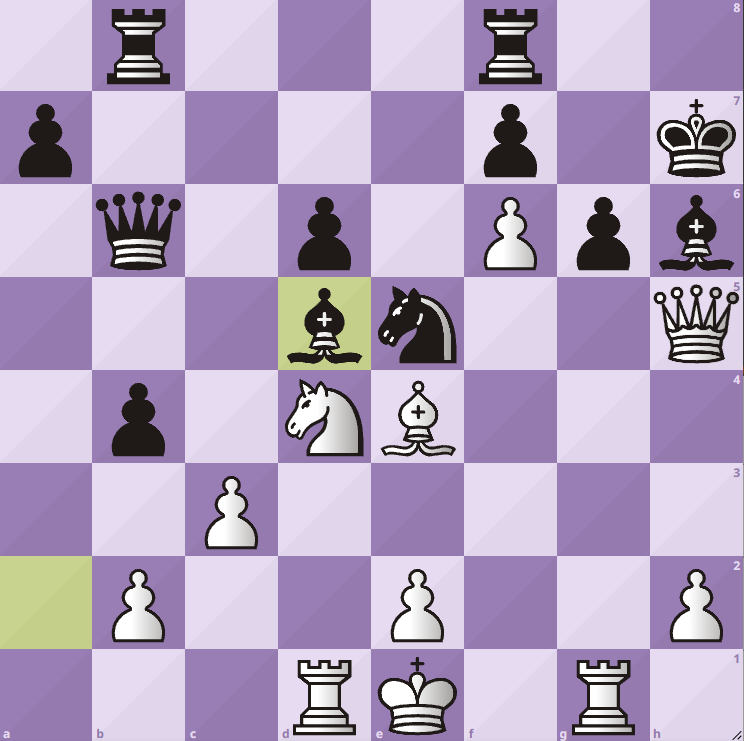
If you found the move, BRAVO. That's a super difficult move to consider in a position like this in my opinion. If White had found that with so little time on the clock I would have been absolutely floored.
Honestly, I don't quite remember why I chose Bd5 over d5, but I got lucky that it didn't come back to bite me.
27. Bxg6+ fxg6 28. Rxg6 Nxg6 29. Qxd5 Rxf6 0-1
Takeaways!
It was nice to finally get a win in the tournament. I'm on 1.5/4 now with two more rounds to go. I was clearly playing a bit more confidently in this game, and I was very happy with actually going for it early. I'm hoping to actually get back to some chess training now that things with my job have slowed down, so maybe I will have more to discuss in the upcoming posts!
You may also like
 ChessMonitor_Stats
Where do Grandmasters play Chess? - Lichess vs. Chess.com
This is the first large-scale analysis of Grandmaster activity across Chess.com and Lichess from 200… Mike-Shea
Pieces of wood
Welcome to my 2nd blog post in my OTB Adult Improvement journey. This game features a nice positiona… FM MattyDPerrine
Higher-Rated Players Want You to Be Afraid of Them
Your fear is their biggest weapon. Here's how to stop handing them the game. thibault
How I started building Lichess
I get this question sometimes. How did you decide to make a chess server? The truth is, I didn't. Mike-Shea
Letting lower rated players defeat themselves
Hello! Welcome to the blog about my OTB Adult Improvement journey. I would like to use this blog as … Mike-Shea