How I Analyze My Games
In this post, I'm going to break down how I analyze my games. I believe this method will be effective for any beginner, and I'll explain why in each section. For intermediate and advanced players, I have also mentioned what I think is best, but note that this is based on research, not experience.
What NOT To Do
Odds are, if you've read through any game analyses, they were designed for you to read, not for the author to learn from the game. Think about that. Many people analyze a game simply by going through and making a comment/evaluation for several moves, trying to determine how good it was and weight its pros and cons. But remember one thing: the goal of every single step of game analysis is for you to learn from it, not others. This is how I've made my method, and this is an important principle that should shape yours.
Thanks to IM David Pruess for explaining this to me.
Software
I personally use ChessDojo to analyze my games, but the software doesn't really matter. All you need are the abilities to add comments, use the engine, add glyphs, and add variations, which all websites should have. If you're more advanced, you may prefer one software for its opening-repertiore-related features.
What to Analyze
I personally only analyze a game once every two weeks. If I go to a Classical tournament, I choose a game from there. Otherwise, I play a game, complete steps 1-3, and complete step 4 the next day. GM Noel Studer explained why playing Classical isn't necessary in one of his recent videos, recommending Rapid instead. I agree, as I still think pretty deeply in 15+10.
Why not analyze every single game? Analysis is a time-consuming and possibly boring process. You wouldn't have time to do other things if you decided to analyze every game. That's why I recommend blunder analysis, a method described here.
The Opening
I get that it's common advice for beginners not to worry about openings and instead focus on tactics, playing, analyzing, and endgames. After all, having a good position out of the opening, at most levels, won't matter in the game as it's decided by tactics. However, let me explain my reasoning here.

You shouldn't be having repertoires that you memorize, whether blindly or with understanding. What I'm saying is that, for the purpose of saving time, you should simply play through the opening, find the first move where you hesitated and had to think, and figure out what to do next time and why. It's important to have a reason behind every single move. You may have to play through a few variations to make sure that the move you made is sound, but I recommend attempting a mental calculation first. I also recommend doing this as soon as possible after the game, or at least the first part of it, when your thoughts are still fresh in your mind. That way, it's easier to figure out when you first hesitated.
Don't use the engine; it's unnecessary. Don't worry about the moves after that. Just make a simple decision. Don't put all of these decisions in a single file; then it becomes a repertoire. Just write down, in the PGN of the game itself, what to do. If you forget, just think about it again in the game.
For those players more advanced, I'm not exactly sure what is necessary, but I'd recommend GM Studer's video on how each rating level should study openings.
Strategy
This is something I believe all players should do, regardless of skill level.

What the heck is this guy talking about?
Let me explain. I read on a ChessMood blog post once about the bold/unbold method. GM Grigoryan (might be misspelled) had a hard time remembering strategical motifs that he learned about. Years later, he came up with the bold/unbold method. Basically, you were supposed to make a list with detailed notes about all strategical motifs you'd learned and bold everything. Before each game, you'd read through the list. Afterward, you'd then unbold anything that you thought of. You would repeat the process, focusing only on the bolded items before each game.
So I thought, Only one repetition. Sure, that'd be helpful, but the more times you repeat something, the better it sticks, right? My solution was simple: italicize, highlight, underline, and change the font color of the list along with bolding it. The process remains the same, but you read through every single item on the list, and every time you thought of something, you undo one edit. After that, you decrease the font size, one point by one point, until you can barely read it. Finally, you strike it out, signifying that you've repeated it many times, and it should've stuck by now.
The reason GM Grigoryan only bolded each item was because his list kept growing, and I believe it does at higher levels, where positional study is more important. But at lower levels, you should spend less time studying strategy, so you'd have a smaller list and need for more repetition. Add as many "edits" to your list as you feel are reasonable at your level.
You may have to play through your game to confirm whether you thought of something. Again, I recommend doing this ASAP for the same reason.
I also believe that any positional/endgame motifs that you learn should be added to this list, and that this step should be done with every single game you play. Of course, if you're learning the exact endgame technique for a certain position, then it wouldn't make sense to be on your list. After all, it probably won't come up too often, and so the best way to make sure you remember it when it does come up is by repeating exercises on it. For other motifs, you can likely consider it at any point in the game, such as exploiting outposts.
I unfortunately have not made a bold/unbold list for you yet because I haven't studied any motifs since returning to chess.
Endgame
Again, this is something I think should be done regardless of skill level.
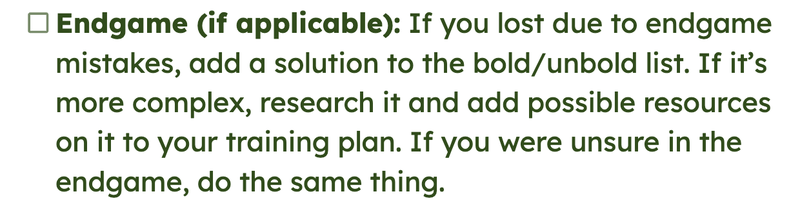
This one is pretty self-explanatory. Did you lose because of an endgame mistake that isn't a tactical blunder? Were you unsure and hesitant in the endgame? If you answered yes to the first question, then figure out where you went wrong. If it was simple, like ignoring a passed pawn or not developing the king, that's something you should add to the bold/unbold list. If it was due to the intricacies of a certain position, or you answered yes to the second question, search online for anything explaining what to do in that endgame. Add any resources to your training plan, making sure they aren't too complex for you. Don't take away time from playing or tactics.
This step is also recommended ASAP because you need to gauge your sureness in the endgame.
Tactics: The Most Important Part
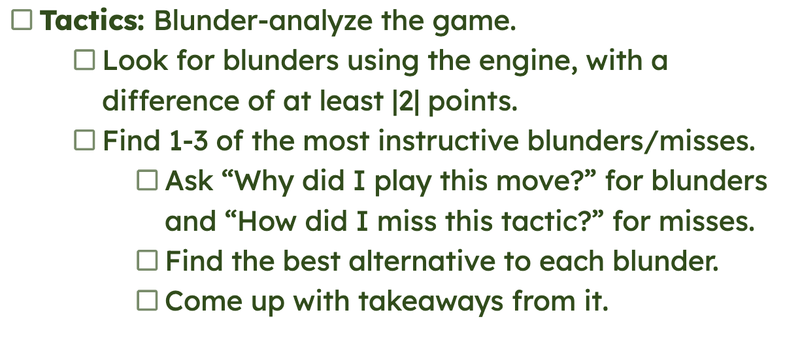
Note: In this case, a "miss" refers to a tactic that you didn't notice in-game, even if it doesn't work.
Blunder analysis, which I mentioned before, is a technique best done later rather than sooner. However, one of the subsequent steps requires the game to be relatively fresh in your mind, which is why I personally do this step the day after the game. I also recommend marking each blunder and adding a brief comment explaining why it's a blunder to help with future steps.
Using the Engine
But don't most people tell you not to use it?
The engine must be used for tactics only and after you've already gone through yourself. This will help you find tactics that you missed when you went through manually, which you still need to learn from. But be warned: if a tactics seems too deep and advanced for you, don't waste time on it and just ignore it.
How do you know if a move is a tactic? My rule of thumb is if the evaluation changes by 2 or -2, one side likely blundered. However, play through the top line too confirm that there's a tactic, because there isn't always one. Also make sure that you explore any possible alternatives that could've prevented the final loss of material.
Consolidating the Blunders
You can learn from every single blunder. But that'll just fill your bold-unbold with too many ideas. Ultimately, it'll cost you more to focus on all of those ideas than you'll actually get. Instead, GM Noel Studer recommends only looking at 3 positions. His method is slightly different, but I recommend finding 2 blunders/misses that are similar to mistakes from other games. If you lost, find the one blunder/miss that decided the game. If you won, then find 3 mistakes that are similar to other games. Then, figure out why you blundered a piece or why you missed a tactic* and come up with a way to prevent that in the future.
*This is the part that needs the game to be fresh in your mind.
Example
This example has:
- an in-depth analysis of the first position where I was unsure
- all of my blunders, marked and explained briefly
- an engine line were the eval changed by -3.4
- I realized wasn't tactical and too advanced to worry about
- a few takeaways from the most instructive blunders
You may also like
 Vihaan7387
Estimating Chess.com Diamond Value (The Results Might Surprise You)
I'm going to look at each of Chess.com's individual diamond features and give my estimate for their … Vihaan7387
GM Noel Studer
Today I want to talk about my favorite grandmaster, Noel Studer and what I like and dislike about hi… Vihaan7387