
How the Last Moved Piece Affects the Next Move
Looking at how the frequency of moved pieces and board sides of the moves changes based on the previously played moveIn theory, a move in a chess game should only depend on the current position and not on what happened before. However, we all know that in games, players often make decisions based on the previous moves, either because they want to execute their plan or react to a move by the opponent.
In this post, I’m going to take a look at how the previously moved piece and the board side affect the moves played in games.
I collected all the game data from 3+0 games from the Lichess database and looked at players rated 1000, 1400, 1800, 2200, and 2600, as players should be more objective as their ratings increase. I only used moves where players had more than 30 seconds left on their clock to reduce the impact of time trouble on the moves.
I’ve also separated the data into moves played in the opening and the middlegame.
Piece type moved
Firstly, I want to look at how often each piece type was moved.
Opening
To start with, I want to look at the relative number of moves in which each piece was moved in the opening.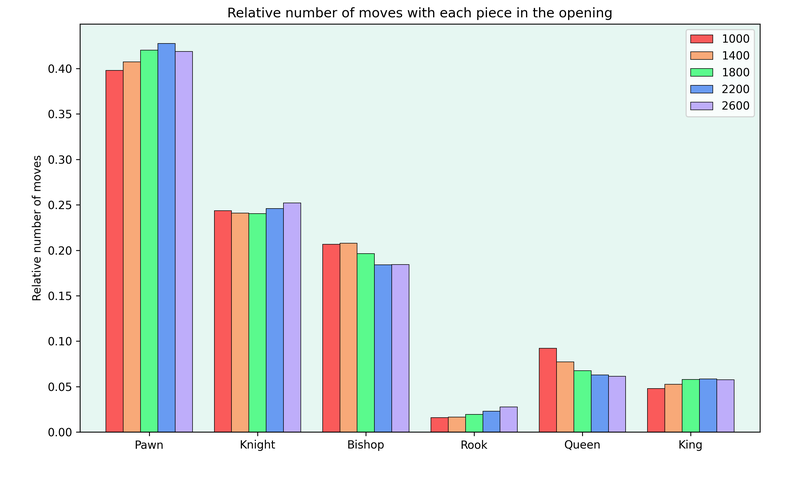
Overall, the data is relatively even among the different rating levels, with some minor trends. Higher-rated players move their pawns, knights, and rooks slightly more often, while moving the bishops and queen less frequently.
The data for the queen in particular is interesting, as it falls off quickly from 1000 to 1400 and from 1400 to 1800, but is somewhat stable after this, probably because players have internalised the “don’t move your queen in the opening” rule by then.
Next, I want to look at how the previously moved piece affects the move frequencies of the different piece types on the following turn.
Below you’ll see one graph for each piece, which shows the move frequency of every piece type after the piece in the title has been moved by the same player.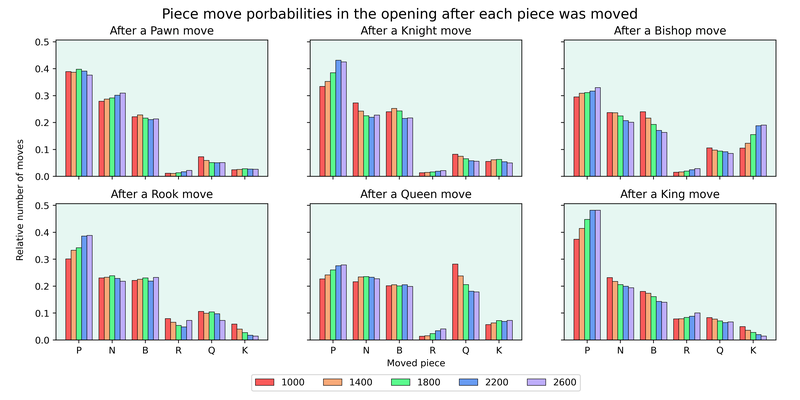
The clearest trend is that higher-rated players move their king much more often after bishop moves, which again follows general opening principles of castling early and moving knights out before bishops.
Finally, we can also take a look at the relative number of moves that the same piece was moved twice in a row in the opening.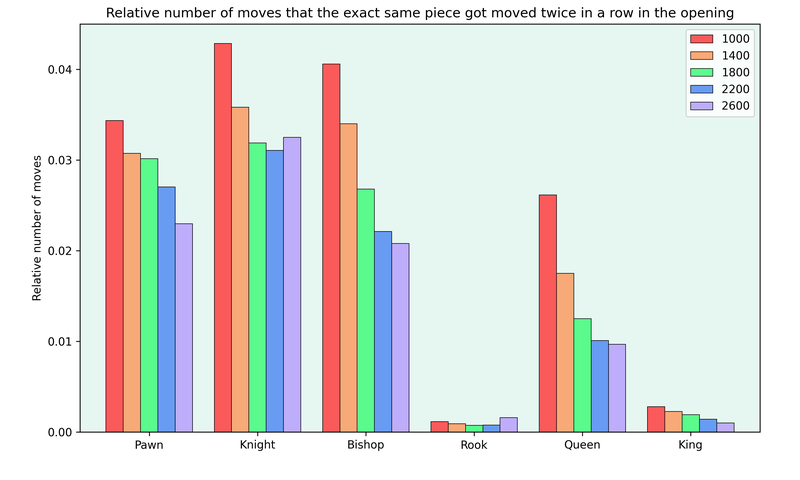
Again, this shows that higher-rated players adhere more to general opening principles, this time not moving the same piece twice. One notable exception is rook moves, which may hint that higher-rated players make more rook manoeuvres in the opening.
Middlegame
We can now also look at the same data for the middlegame.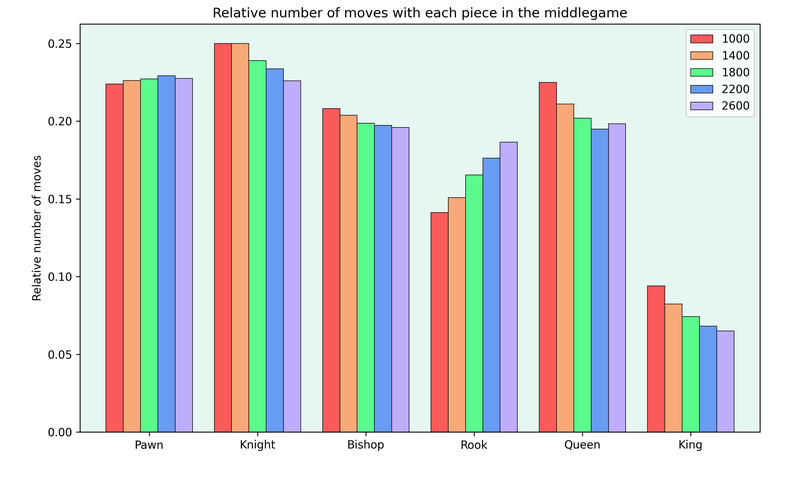
The biggest difference among rating levels is that higher-rated players use their rooks more often and move most other pieces less frequently. This leads to a fairly even number of moves with every piece apart from the king for 2600-rated players.
We can now also look at how these probabilities change depending on the previously moved piece type.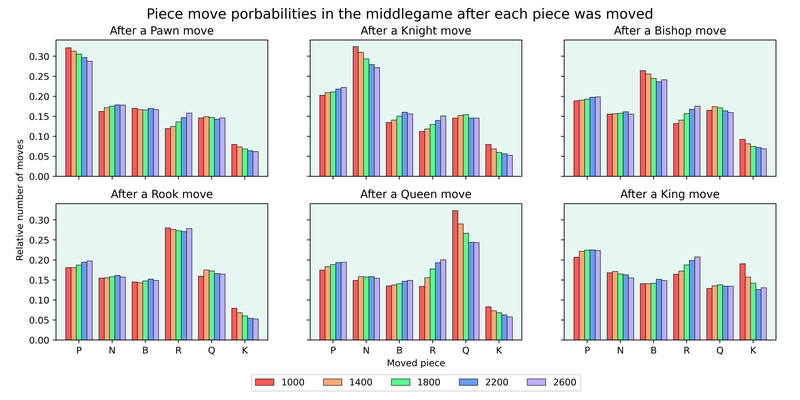
Interestingly, players of all levels tend to move the same piece type consecutively very frequently.
We can again look at the number of consecutive moves with the same piece.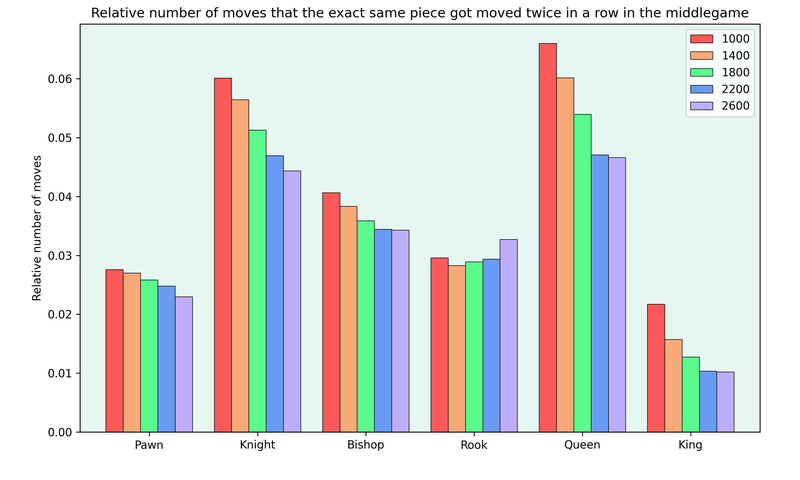
The relative number of moves with the same piece generally goes down as the rating increases. The only slight outlier is rooks, which again may hint at higher-rated players playing more rook manoeuvres.
Board side
I also want to look at the side of the board where the moves are happening. I assume that moves by higher-rated players will be distributed more evenly across the queenside, center, and kingside.
I categorized the moves based on the square where the piece ended up and grouped the a-, b-, and c-files as the queenside, the d- and e-files as the center, and the f-, g-, and h-files as the kingside.
Opening
Let’s start again by looking at the overall numbers in the opening.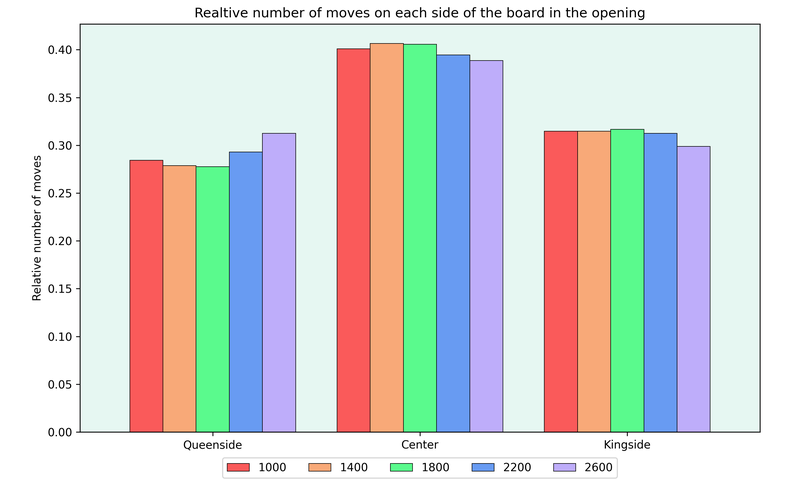
Unsurprisingly, all players make more moves in the center than on either side of the board in the opening. Players rated 2600 make about the same number of moves on the queenside and the kingside in the opening, while players rated from 1000 to 2200 tend to prefer the kingside over the queenside.
We can again take a look at how previous moves affect this data. This time, I’ll look at the board side of the previous move by the player themselves and the previous move by their opponent.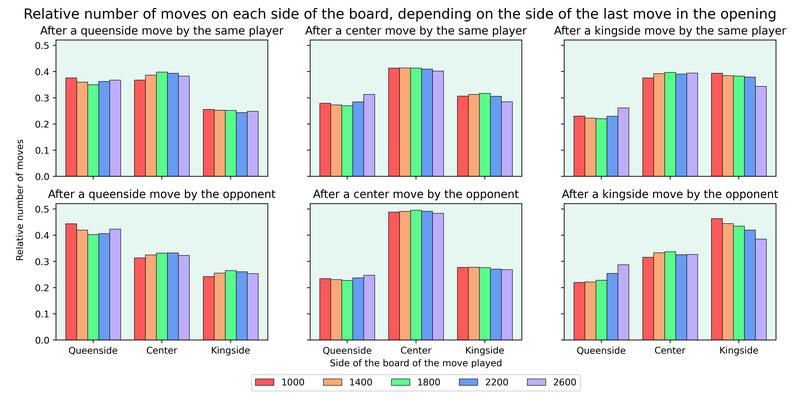
In general, the side of the last move by the opponent influences the move made by a player more than their own last move.
The individual graphs also show that higher-rated players play more on the queenside when the previous moves were on a different side of the board, but when the previous move was on the queenside, players of all levels react similarly.
Middlegame
We can now look at the same data in the middlegame.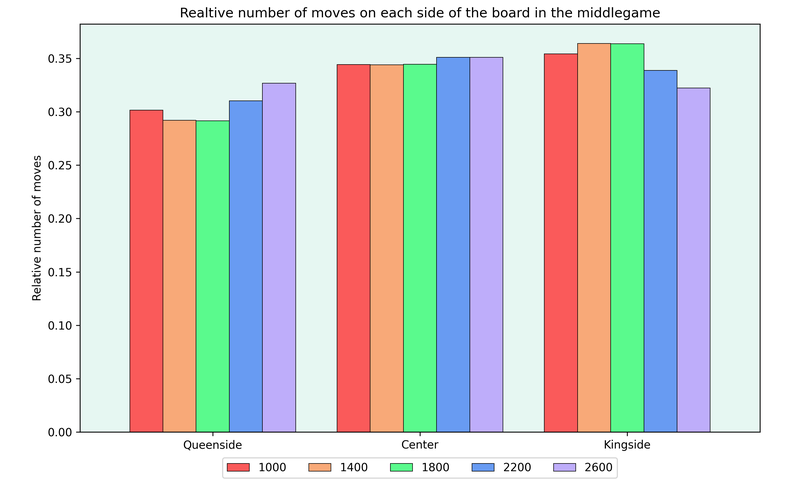
As was the case in the opening, the 2600-rated players play more on the queenside, and as there are fewer central moves than in the opening, strong players play around the same number of moves on all parts of the board. It’s also interesting to see that the number of kingside moves peaks for players rated 1400-1800.
Finally, we can look at the number of moves on each side of the board depending on the previously played move.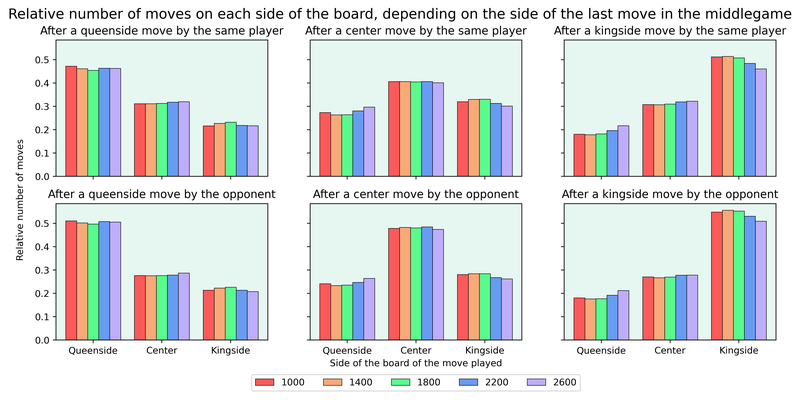
The data here is as you’d expect from everything we’ve seen up till now. The previous play seems to affect the current move more in the middlegame than in the opening, which makes sense as both players are creating threats and carrying out longer-term plans.
Final thoughts
There are obviously many other factors that affect moves in the game, but I found it really interesting to see some trends with different rating levels without considering any specific positions.
There are many other factors one could look at, so let me know if there’s anything in particular you’re interested in.
If you've enjoyed this post, check out my Substack.
You may also like
 thibault
How I started building Lichess
I get this question sometimes. How did you decide to make a chess server? The truth is, I didn't. jk_182
How have White's Responses to the Najdorf Changed over the Years?
Looking at popularity of white's 6th moves in the Najdorf variation jk_182
How the Evaluation and Clock impact Results of Blitz Games
Looking at Lichess games to find the effect of the remaining time and evaluation Fire-work
I made a program to find craziest sacrifices in a row. Here is what it found
"Aren't those 2 bishops our last hope? Surely not, we can sacrifice them to create a perfect checkma… CM HGabor
How titled players lie to you
This post is a word of warning for the average club player. As the chess world is becoming increasin… CkickyCheck