
History of the Knight: Increase Your Horsepower
An Exploration.
Increase Your Horsepower
"I fear the Greeks even when they bring gifts" — Trojan priest Laocoön, Latin epic poem Aeneid, Virgil, 29-19 B.C.
The Greeks were in a 10 year siege against the city of Troy. An old legend claimed that chess was invented by Palamedes, the son of King Nauplius in order to entertain the bored soldiers. Laocoön was a Priest in Troy. He warned them about accepting a gift from the Greeks because he was suspicious. Laocoön then passed away via sea serpents. While pretending that they had given up on the war, the Greeks offered a giant constructed wooden horse as a gift to the people of Troy. But inside there were hidden soldiers. Then when the horse was in the city, the soldiers leapt out in a surprise attack. They made the people of Troy pass away sadly. Because it was a sad war. But luckily this is a fictional story from Homer's Odyssey and Virgil's Aeneid.
 The Procession of the Trojan Horse in Troy, Giovanni Domenico Tiepolo, Painting, ~1760 A.D. Source

Horses were domesticated from around 3000 B.C. as we know from burial remains. Domestication is when an animal is selected and trained to work with humans. This is done by first selecting the most approachable horses. Then those horses are bred. This means that genetic variation in horses that let humans be with them becomes more prevalent in that evolutionary line. Also horses are trained from when they are young, humans first establish trust, and then they place the saddle on the horses to get them used to it. Horses are only ridden on when their growth plates are closed at about two years old so that the horse does not become injured from the weight of the rider.
But how did the knight arrive and come to have it's wonderful powers?
Evolution of the Knight
Horses were used in warfare. Mainly for transporting artillery, ammunition, food and medical supplies because they could carry the stuff. They were not commonly used in charging the enemy in battle as depicted because this is wasteful and the horses could be injured easily. In Ancient India, horses were part of the army (chariots, elephants, horse and infantry (soldiers)). Cavalry is the name for soldiers on horses.
The Greeks (as seen in the Troy story) were known for invading other people. In 326 B.C. Alexander the Great invaded India and won. The Greek accounts said that there were 4,000 Indian cavalry in the battle. The four elements of the army were called Chaturanga - which used to be the name of chess. This is one of the reasons why historians say chess came from India in the 6th century (this is not a universally agreed position, some historians think it is not certain and chess may have come from Persia/or China/or a mix). Chess did proliferate in Persia and then the Arab world after the Rashidun Caliphate conquered the Sasanian Empire in the 7th century.
The knight moves like an 'L', with a combination of 2 steps and then 1 and vice versa. Speculatively, this may have been because horses are known to move in a chaotic way sometimes, so they made the piece chaotic.
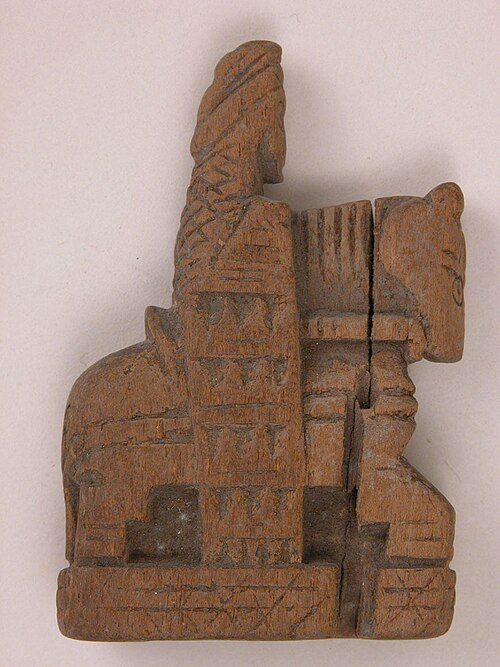 Back in the day the knight was depicted in how it was meant to be. A depiction of cavalry with a solider riding the horse. Piece from Egypt, 7th–8th century. Source

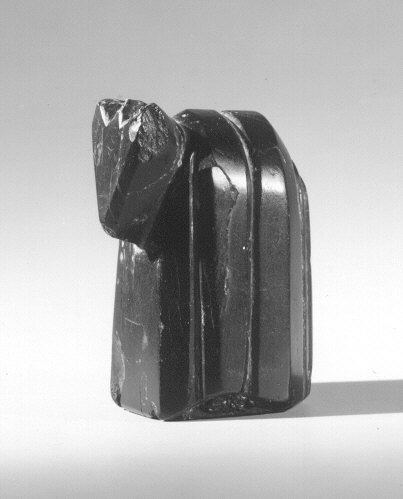 The knight became more abstract as Caliphal decrees resulted in chess being banned. So it is thought this is why the design of the pieces became more abstract, to get around the ban. The abstract designs influenced European chess sets as well. Piece from Western Islamic Lands, 8th–10th century. Source

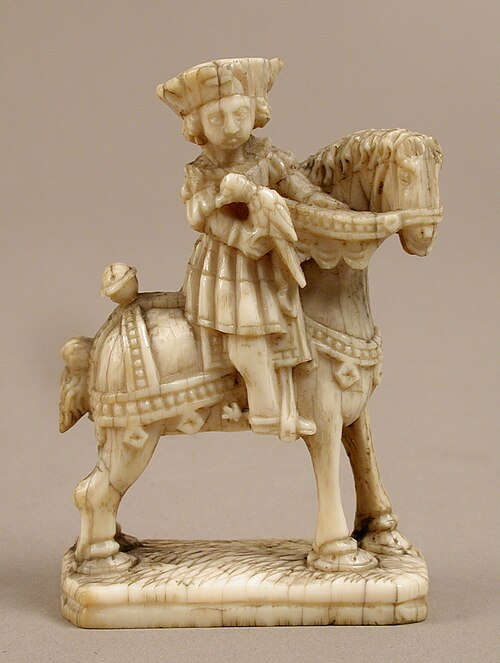 Chess spread to Europe through Spain at the beginning of the 11th century. Piece from Netherlands, ~ 1500. Source

By the 19th century, there were multiple chess sets in Europe with different designs. Instead of depicting people the pieces were more abstract and now the knight was just the head part instead of the full body. Speculatively, this may have been because it was easier to mass manufacture more simple designs. The famous Staunton Chess Set was created in 1849 by Jacques of London, a sports equipment and board game manufacturing company. The Staunton is the official FIDE chess set. Howard Staunton promoted the chess set by endorsing it in an advertisement in the Illustrated London News. It is characterized by the pieces having a weighted base at the bottom which keeps the pieces sturdy, in contrast to some other sets with thin shaped pieces. There is no standardized face design for the knight.
The Analysis
The knight is prominent in brilliancies. Let's have a look.
Paul Morphy used the smothered mate back in the 1800's in a famous miniature:
Bobby Fischer won a brilliancy prize for his game against Robert Byrne at the 1963-64 U.S. Championship where after planting a knight on d3, he launched a surprise attack against Byrne's King:
The Byrne game was quite fabulous, and I cannot call to mind anything to parallel it. After White’s eleventh move I should adjudicate his position as slightly superior, and at worst completely safe. To turn this into a mating position in eleven more moves is more witchcraft than chess! Quite honestly, I do not see the man who can stop Bobby at this time...
K. F. Kirby, editor of the South African Chess Quarterly, quoted in My 60 Memorable Games, Bobby Fischer.
And as I sat pondering why Fischer would choose such a line, because it was so obviously lost for Black, there suddenly came 18... Nxg2. This dazzling move came as the shocker...The culminating combination is of such depth that, even at the very moment at which I resigned, both grandmasters who were commenting on the play for the spectators in a separate room believed that I had a won game!
Donald Byrne, quoted in My 60 Memorable Games, Bobby Fischer.
Garry Kasparov planted an octopus knight on d3 against Anatoly Karpov during Game 16 of the 1985 World Championship Match. He then positionally squeezed Karpov in a way which was unprecedented and brilliant:
Challenger Gary Kasparov scored a stunning victory yesterday in Game 16 of the world chess championship match in Moscow -- a victory that left more than 1,000 fans in the Tchaikovsky Concert Hall stamping their feet and shouting "Gary, Gary" minutes after the players had left the stage.
Joseph McLellan, New York Times, October 15, 1985
Such games are remembered for a long time, and in particular by the player himself, having literally put part of his soul into the sustained realisation of his plan. Earlier too I had succeeded in carrying out pretty combinations, making spectacular sacrifices of material, and conducting complete strategic games, but none of my earlier creations on the chess board can compare with this 16th game as regards the grandiosity of the overall conception. A particular value was imparted to this win by its status: it was gained over the world champion in a match for the world crown. Moreover, it has withstood the test of time: in Black’s play from the 12th move onwards, even the computer has been unable to find fault!
Garry Kasparov, On Modern Chess, Part 2: Kasparov vs Karpov, 1975-1985, p.364
The Laws of Knight Physics
Observe the following image:
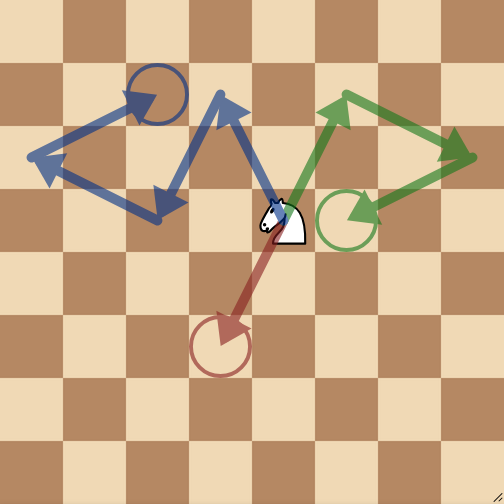
This shows how the knight gets to a square depending on the destination. Euclidean Distance is simply normal distance, treating the squares like a object that can be measured. Straight to the right (green) is '1' distance. The diagonal distance (blue) is sqrt(2^2+2^2) = sqrt(8) = 2.83 (Pythagoras Theorem). The one move distance (red) is sqrt(2^2+1^2) = sqrt(5) = 2.24.
This chart shows how the moves change based on distance:
 The Number of Moves vs Euclidean Distance.
As you can see, the knight defies the law of physics by moving faster as distance increases. Then it suddenly goes from 1 move for 2.24 units to 4 moves for 2.83 units.
That spike represents when a knight has to go to a square that is 2 diagonals across. This means that in Bullet games you know that a King can't be checked quickly by a knight that is two diagonals away. It also means that a knight's effectiveness can be determined by it's position, such as when an outpost is on the board. Wolfgang Unzicker had a knight on b3, while the d5 outpost was two squares diagonally across. This had big ramifications:
To do justice to the knight, we will finish with a dream scenario from Mikhail Botvinnik:
A Hole or Outpost is a square that is not defended by any pawns, and that is supported by your pawn/s. Here the d6 square is not defended by any pawns and the c and e pawns support that square. This makes it ideal for a knight to go hop-hop-hoppity hop all the way to that square. An advanced outpost is especially great because it is in the enemy camp and they won't be able to move around because the knight controls advanced squares.
If the Knight gets to d6 you may wonder, what if the bishop takes it. Well then you get a strong protected passed pawn!
The Essence of a Knight
This leads to a question: what is the knight?
To Lichess it is a mascot, to the Lichess Forum it is a meme, to the grandmasters a tool of their trade, for mathematicians an object of investigation.
Q: What does this tell us about the nature of life?
A: It tells us that life is a mystery. A mystery with a history that bursts into a symphony... Quite right, Quite true and Quite profound.
Sincerely, Immanuel Knight.
NEEEEEEEEEEEEEEEEEEEEIGH
You may also like
 GM Avetik_ChessMood
10 Things to Give Up to Enjoy Chess Fully
Discover how embracing a lighter mindset can help you enjoy chess again and achieve better results. FM MathiCasa
Chess Football: A Fun and Creative Variant
Where chess pieces become "players" and the traditional chessboard turns into a soccer field RuyLopez1000
Bishop vs Knight Forever and Ever
The Bishop's Corner. thibault
How I started building Lichess
I get this question sometimes. How did you decide to make a chess server? The truth is, I didn't. CM HGabor
How titled players lie to you
This post is a word of warning for the average club player. As the chess world is becoming increasin… NM ZugAddict