
Instructive Endgame: Knight vs Bishop
How to play a knight vs bishop endgame.
Hello Friends. I am RuyLopez1000 and I will be showing you an educational endgame that will help your chess.
I will show you how to try to win an position where you have a knight vs bishop in the endgame.
Let us begin.
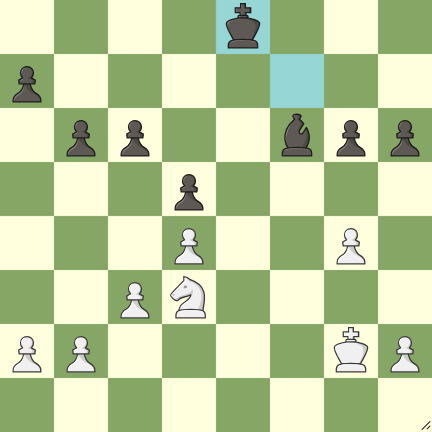
Observe the endgame. White has a knight, Black a bishop. Bishops are said to be better in open positions where pawns are on both sides of the board. The position is relatively closed. Only two pawns have been exchanged off, meaning the board is still quite full, which limits the bishop's scope. So pawns being on both sides of the board is not so relevant. The knight is flexible and invincible on the light d3 square while the bishop can only move on the dark squares. The position is equal, but White is preferred practically.
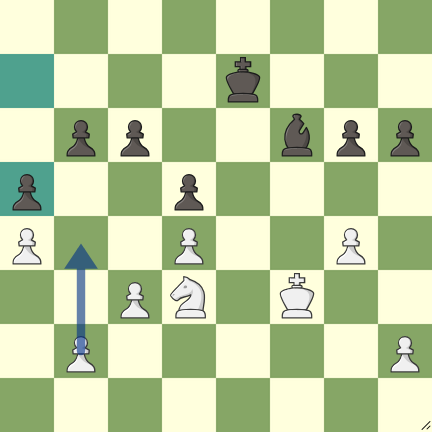
I played a4 to provoke a5. This benefits me as now b4 is on the table. a5 is fine according to the computer, but it is practically better to avoid fixing pawns on the same color as the bishop. b4 is now a strategic idea as if they take axb5, then I have potential for a passed pawn after a5. The d4 pawn will need to be defended before doing this and the b4 break should be timed correctly. On the other hand, if they do not take then I have the possibility of bxa4 which will make the a pawn a target in the future.
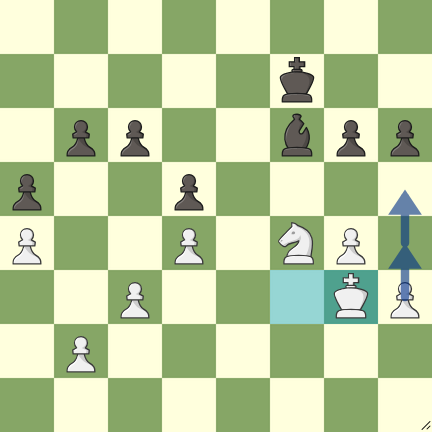
After some shuffling I bring my king to g3 to enact the plan of playing h4-h5. The idea is to cement the h6 pawn as a target and fix the h pawn on a dark square. Fixing Black pawns on dark squares is what I want as it makes the bishop bad as the bishop will have to defend them, while they can't attack my pawns. They could play Be7 now to play Bd6 after h4 to try to trade their bishop for my knight as a counter-plan to avoid their bishop being stuck defending the h6 pawn later. To avoid this I could play Nd3. In the game they played Bg5, to which I also replied Nd3 to avoid the trade.
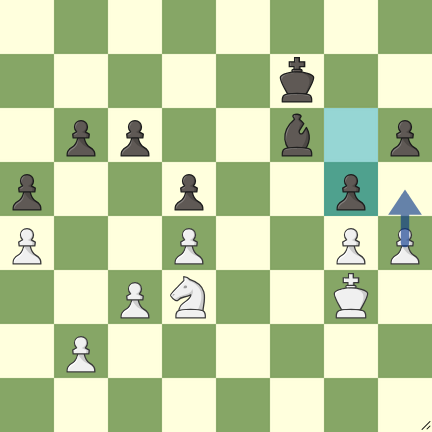
After h4, they played g5 themselves. It would be better to let h5 happen and exchange pawns with hxg as exchanging pawns is a good defensive strategy. However, computer says this is still fine. I replied h5, which locks the h6 pawn as a permanent weakness. Exchanging would allow the Bishop to get more active after Bxg5. The bishop must stay on f6 to stop Ne5+ winning the c pawn.
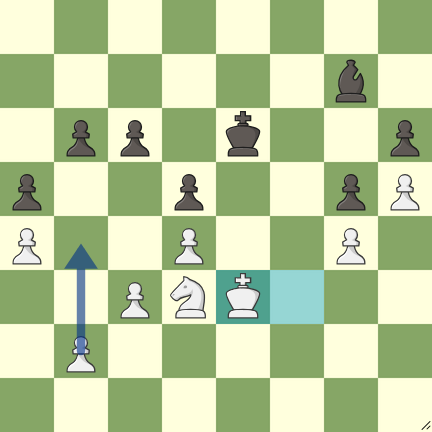
There are two possible ideas. One is to bring the knight to f5. But at the moment the h pawn can still be defended. So I choose the idea of b4 as described above. I can either take on a5 to create a weakness, or if they take after b4 I now have the possibility of creating a passed pawn. First I bring my king to e3 to defend d4. So that after axb4, the d pawn is defended.
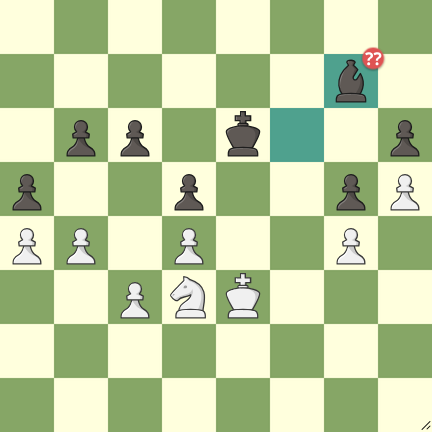
After b4, they blundered with Bg7. Spot the tactic.
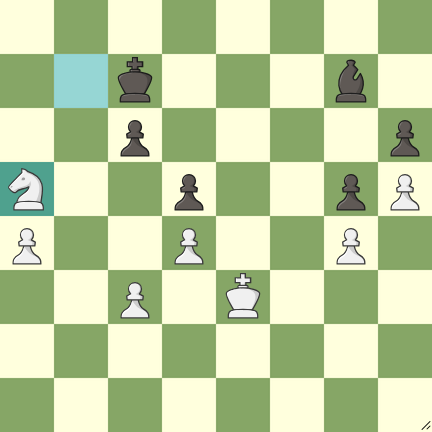
After bxa5! bxa5 I played Nc5+ followed by Nb3/b7 to win the a pawn. But I can't push it with just the knight. I need to activate my King. Be7 would have held the position as it would cover the c5 square. If bxa and then Nc1-b3, The a pawn could also have been defended with Bd8.
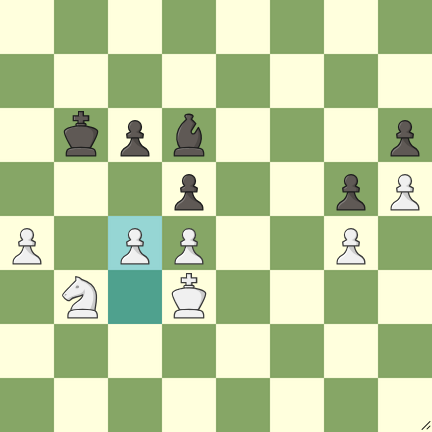
I leave my Knight on b3 to stop Ka5 from attacking the a pawn. I bring my king to d3 to support c4. If takes then my king advances. Otherwise I take on d5 and create a new weakness.
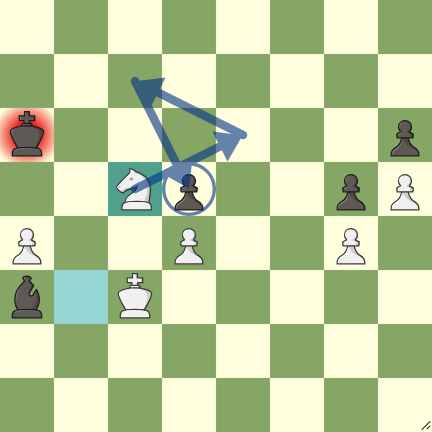
Later I took on d5 and played Nc5+. With the idea of winning the d pawn to open the c4 square for my king. If they take the knight with the bishop then I have two passed pawns and the d will be won easily. I played Ne6-c7-xd5 to win the d pawn. They played Be3 to win the d pawn but that didn't matter. Now the center was open and I marched my King to the Kingside, while Black's King had to take the a pawn. I'd show an image here for this stage but Lichess only allows 10 images per blog. If they played Bf4 to stop Nc7 after Ne6, I could play Nxf4 and Kd3 to get into the square of the f pawn. Then I would create another passed pawn with g5, hxg, h6 (marching the passed h pawn).
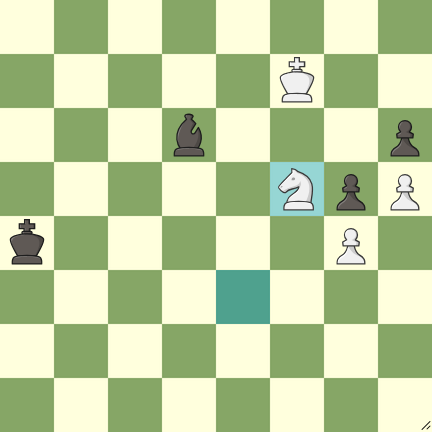
This was the final position. I marched the King to the Kingside and put my Knight on f5. Meanwhile the Black King couldn't defend as they had to take care of the passed a pawn. This is easier then trying to advance the passed pawn. My Knight and King can easily win the Kingside pawns. With two passed pawns and a faraway Black King this is an easy win.
And that's how to play a knight vs bishop endgame.
Lessons for knight vs bishop endgame:
1. The knight is better if the position is relatively closed, with lots of pawns still on the board.
2. Provoke or fix pawns on the same color as their bishop through pawn advances. This makes the bishop defensive and limits its squares.
3. Use pawn breaks to create a weakness or to allow the possibility of a passed pawn.
4. Also use pawn breaks to open squares for your pieces.
5. If you have a passed pawn and the opponent has weaknesses that can be won on the other side of the board, you can go there while the opponent needs to defend your passed pawn, allowing you to win material easily.
I hope you enjoyed and learnt from this endgame tutorial.
Till next time! - RuyLopez1000.
You may also like
 RuyLopez1000
Bishop vs Knight Forever and Ever
The Bishop's Corner. GM Avetik_ChessMood
10 Things to Give Up to Enjoy Chess Fully
Discover how embracing a lighter mindset can help you enjoy chess again and achieve better results. ChessMonitor_Stats
Where do Grandmasters play Chess? - Lichess vs. Chess.com
This is the first large-scale analysis of Grandmaster activity across Chess.com and Lichess from 200… CM HGabor
How titled players lie to you
This post is a word of warning for the average club player. As the chess world is becoming increasin… FM MathiCasa
Chess Football: A Fun and Creative Variant
Where chess pieces become "players" and the traditional chessboard turns into a soccer field thibault