
What the scoreboard never tells you
Why results are the worst judge of your chessOne of the games I regret the most
April 2022. My FIDE rating was at its peak, 2457, and I’d flown interstate to play the Begonia Open in Ballarat, Victoria. I won my first three games, and in Round 4 I was on Board 2 with White against Australian GM Zhao Zong-Yuan. After move 15, he offered a draw in this position: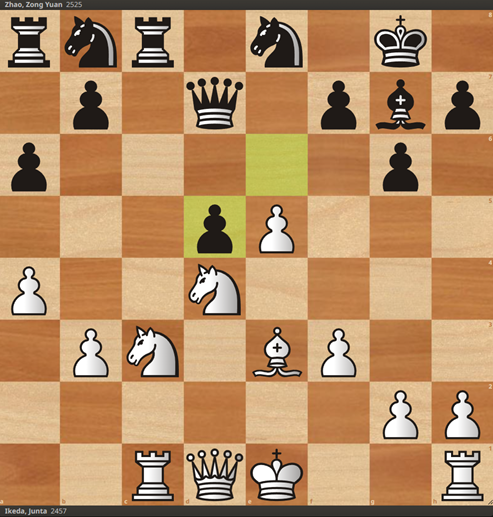 And I’m ashamed to say I took it.
My excuses: Begonia is a brutal event with 7 rounds over 3 days, and on the Sunday you play 3 games of 90+30 (I reckon this is an Australia-only torture) that can each run past 4 hours, at 9:30am, 2:30pm and 7:30pm. This was the 2:30 game. I’d neglected my fitness through 2021, stuck at home for much of COVID, and by Round 4 I was already exhausted.
But that same night, I ground out a 66-move win in Round 5 that finished at 11:30pm, so I clearly had the stamina when I needed it, like Messi in the last 20 minutes of the game against Egypt or the last 15 minutes of the game against England.
The real reason was less flattering: a draw with a grandmaster kept my rating where it was.
I’d held a 2450 or so rating through the COVID years when there weren’t many tournaments, and I was worried that I hadn’t maintained my strength in that time. I was more scared of losing than I was of not learning, which I see now as the bigger fear because the player who keeps fighting keeps learning, and the player who keeps learning keeps improving. But I was insecure and took the safe option.
And just look at this position - still a whole battle ahead.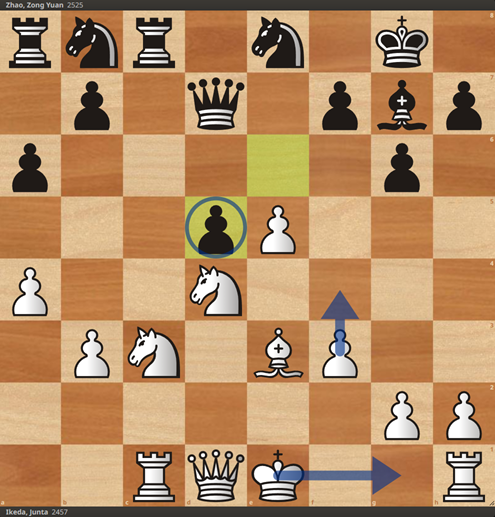 I can play f4 and castle, Black has an IQP with no obvious compensation... and most of all, I’d flown interstate to play this tournament, my first in 8 months and I was playing a grandmaster draw when I’m not even a GM?
Maybe you’ve also put too much value on results in your chess. You shake hands, blurt out “well played”, set the board back up and the replaying starts. While driving home you think of the moves you could have played, in the shower that night you go over the moves you should have played, and you keep refreshing your results page as if the score might flip and the rating might climb on its own.
 Photo by Magnus Andersson on Unsplash
And if it was a painful loss, the thought sneaks in: maybe I’m just not good. What’s strange is how fast that thought can pop up. You go into a game feeling good, but a few hours later you feel like a failure.
That’s the danger of letting results decide how you feel about your chess. Sometimes they crush you after a loss, and sometimes, like me at Ballarat, they nudge you to play safe to keep the shiny numbers intact. You’ve handed over the keys to your confidence to the numbers beside your name.
What the scoreboard never tells you
In chess, you can play the best game of your life and still lose. You can play your best chess in months against a stronger opponent, struggle for four hours, lose in the endgame and walk away feeling like you blew it, when you just proved the work is starting to show.
Results are slow, too. Improvement shows up in your play bit by bit, long before it shows up in your rating. For weeks or months, you can be getting better while the number sits still or even dips. Improvement is never a straight line, so if your confidence is tied to the numbers next to you, you’ll feel like you’re failing even when you’re growing the most. Photo by 愚木混株 Yumu on Unsplash
The judging voice
Timothy Gallwey, in his book The Inner Game of Tennis, put it this way.
The judging voice in your own head does more to your play than the player across the board ever does. And letting go of judgment doesn’t mean ignoring your errors. It means seeing what happened as it is. You still see the mistake, but you don’t turn it into a verdict on yourself because you and your chess are separate things.
But plenty of players treat a loss as proof they’re not good enough, when in reality it’s just a loss, the result of specific things that happened on the board, which you can look at and understand. Photo by Amos K on Unsplash
As humans, we’ve learnt to change our behaviour based on limited information.
- There was a drop bear on that tree, we avoid that tree forever.
- Rain last three days = rain tomorrow.
In chess too, you win three in a row and you feel unstoppable, lose three and you feel like you’ve forgotten how to play. But three games is nothing. The more games you play, the clearer your real level becomes. In a series of 100 games, it’s very normal to have surprisingly long winning streaks and losing streaks.
So if results are this shaky, this noisy, this slow, why do we let them have so much power over us?
Mostly because the result is the only thing we bother to look at, and we see it right in front of us after every game, OTB or online. The rest of the proof: the good decisions, the fears you faced, the things you did better than last month, doesn’t come with a number we can immediately scan so it slips past us. Photo by Ryoji Iwata on Unsplash
Confidence you can point to
For most of my life, I thought confidence was something you either had or you didn’t. But I was wrong.
When you become someone who does the hard things you know you should be doing, especially when they’re uncomfortable and without an immediate payoff, your actions start to match the person you want to be and the confidence follows. It builds slowly, over many months.
That’s what I was missing at Ballarat. For months I’d taken the easy road, buying more opening courses than I needed and telling myself a better repertoire was the key from 2450 to 2500, while avoiding the calculation and decision-making work I needed to do.
So when the decision to play on or take the draw came up, I didn’t want others to see I wasn’t as good as I wanted people to think. The confidence to keep playing could only have come from doing the work, and I hadn’t. Photo by jessi orrico on Unsplash
Confidence that survives a bad loss or a scary opponent has to come from something you can point to. The model games you worked on, the weaknesses you stopped avoiding, the decisions you’re improving a little each week. Building that, game after game, so one bad tournament doesn’t make you collapse, takes a bit of a system so you don’t revert to your old ways. I've been building a video course around this idea for the last five months, and it'll be out on July 22.
As you play chess, you’ll lose many more games you should have won, and you’ll sit across from players who can turn you into a Bambi with one look. But the question was never whether you lose. It’s who gets to decide what the loss means: the numbers next to your name, or you.
[...] On the right a cave where Meaning lies.
On the left the Lake of Deep Conviction.
Truth breaks from the bottom and bobs to the surface.
Unshakable Confidence towers over the valley.
Its peak offers an excellent view of the Essence of Things.
For all its charms, the island is uninhabited,
and the faint footprints scattered on its beaches
turn without exception to the sea.
As if all you can do here is leave
and plunge, never to return, into the depths.
Into unfathomable life.
—from the poem Utopia, Wisława Szymborska
If you enjoy posts like these, I write a free weekly newsletter to over 2,300 chess improvers on Substack. You can subscribe here to receive my posts in your email inbox.
You may also like
 thibault
How I started building Lichess
I get this question sometimes. How did you decide to make a chess server? The truth is, I didn't. IM datajunkie
10 chess books that changed how I see the game
Are chess books still relevant? NM ZugAddict
Are you rated 1600? Good.
It's good to be 1600 and I will explain why IM datajunkie
The best non-chess book I’ve read for chess improvement
The Will to Keep Winning by Daigo Umehara IM datajunkie
You’re studying chess openings the wrong way (do this instead)
If memorising opening lines made you stronger, many club players would be masters. GM Avetik_ChessMood