
The History of Chess Geometry
The Wonderland of the Impossible.
[The universe] cannot be read until we have learnt the language and become familiar with the characters in which it is written. It is written in mathematical language, and the letters are triangles, circles and other geometrical figures, without which means it is humanly impossible to comprehend a single word.Galileo Galilei, Opere Il Saggiatore, p. 171., 1623.
Between 540-430 thousand years ago someone from Homo Erectus engraved some slashes and an 'M' into a shell. At the time the shell would have had a dark covering, and the engraving would appear White. Homo Erectus are our ancestors. This shows they had symbolic knowledge of at least some aspects of geometry:
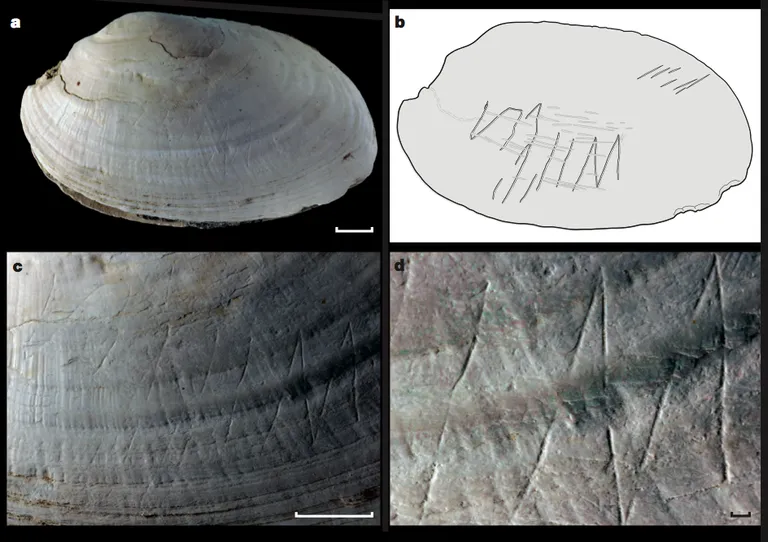 Joordens et al. Homo Erectus at Trinil on Java Used Shells for Tool Production and Engraving. (2014).
Chess was borne from geometry. As the pieces move in geometrical patterns.
Humans investigated geometry. Euclid was a mathematician who published the textbook 'The Elements' in 13 volumes around 300 B.C.. The book is considered to be the most published book in history after the Bible. The Elements was about geometry and was a educational textbook for decades. The book is famous for its 'axioms'. An axiom used to be considered a truth. That it was a fact that was for sure true. These geometrical axioms were:
| Postulate | Description |
|---|---|
| 1 | To draw a straight line from any point to any point. |
| 2 | To produce a finite straight line continuously in a straight line. |
| 3 | To describe a circle with any centre and distance. |
| 4 | That all right angles are equal to one another. |
| 5 | That, if a straight line falling on two straight lines make the interior angles on the same side less than two right angles, the two straight lines, if produced indefinitely, meet on that side on which are the angles less than the two right angles. |
The idea is that geometry starts from these truths, and all other truths can be deduced from them. Geometry described the universe. This was a prominent starting point. Kepler theorized that the distance of the planets corresponded to nested shapes. The reason is because God created the universe, and our knowledge of geometry is divine and represents the language of the universe.
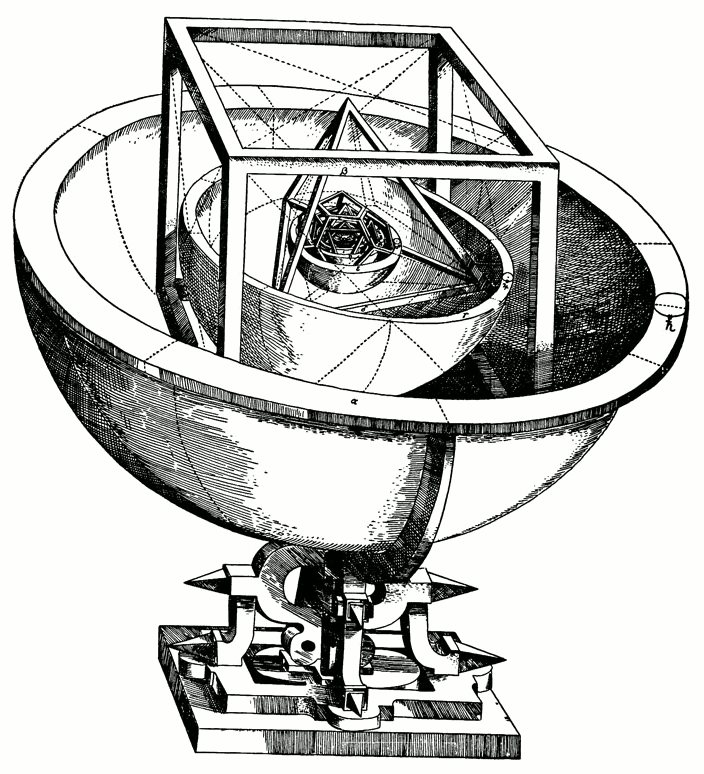 Kepler's model of the universe, the distance of the planets correspond to nested platonic solids.
The postulates (axioms) by Euclid are known as 'Euclidean geometry'. This is the geometry which we naturally think in. It was considered to be the only 'true' geometrical system. As new alternate geometrical systems (e.g. elliptical and hyperbolic) were discovered, the conception of axioms changed from a truth, to simply being something which was given.
A geometrical system was invented were two parallel lines could meet geometrically. How?
Elliptical Geometry: Given a line l and a point P not on l, there exists more than one line through P that is parallel to l.
The answer is to change the geometry. Elliptical geometry 'spherifies' normal 3d space. Every point gets mapped onto a sphere. This will make two parallel lines in 3D space meet up. On the globe, two parallel lines will meet up and the south and north poles.
This shows how counter-intuitive geometrical systems can result in a wonderland of the typically impossible.
The Chase of Two Hares
This is a famous endgame puzzle. White to play and draw. It was dubbed 'The Chase of Two Hares' by endgame composer Abram Gurvich. It appears that White will lose as the Black pawn can't be caught and the King is too far away from its own pawn. The reason this draws occurs is because the White King can go diagonally, reducing the distance to their own White pawn while allowing the King to reach the Black pawn if Black tries to take White's pawn. This is a geometrical riddle. The way the King moves is called 'Chebyshev' distance.
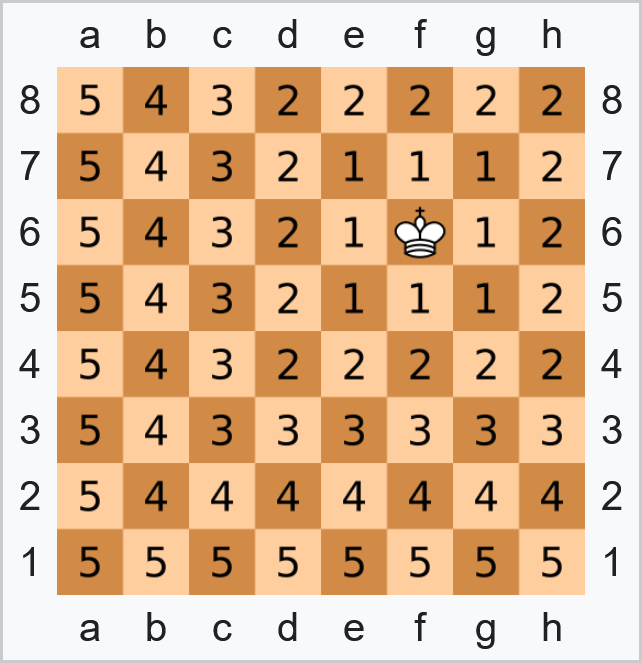 Chebyshev distance. Source: Wikipedia
Euclidean Distance is what we normally imagine in everyday life. Going diagonally would be 1.41 units as pythogaras theorem says that c^2 = a^2 + b^2. The diagonal is always longer. But in chess it is the same. This is the reason for the paradox of the Reti Puzzle. Imagine beings who lived in a universe where Chebyshev distance was physical law. These beings would instantly solve the Reti puzzle and would baffled as to why it is considered a puzzle.
What we call a pin is a collinear arrangement of a attacking piece, and two opposing pieces. What we call fork is when two enemy pieces are equidistant from our attacking piece. It is literally just geometry, a spatial arrangement. But chess doesn't have to be physically spatial. It can be replicated by a set of symbols with transformation rules. The axioms of this system would simply be the rules of chess (e.g. How the pieces move, en passant, the coordinates etc). These rules would be represented by symbols. Transformation rules would allow theorems to be derived through rearranging the symbols. 'p e4' means pawn to e4. But the positions would have to be described by a string of symbols denoting each square and its associated piece.
This would produce output strings. A checkmate can be detected by checking if the squares surrounding the king are attack by other pieces. This would all require a large amount of symbols to represent. But it could be done.
But we do play in a physical world. This leads to illusions like the Reti Puzzle. But how do we see geometry the way we do?
The statistical shape of geometric reasoning
While geometry is often seen as underlying our conception of the physical world, it may also be the case that our perception of the physical world underlies our intuitive geometry.
Hart Y, Dillon MR, Marantan A, Cardenas AL, Spelke E, Mahadevan L. The statistical shape of geometric reasoning. (2014)
The above authors ran an experiment. An incomplete triangle was presented. People had to click on the point where the corner would be if the lines continued. This was done for triangles of different side lengths, and with the angles varied at 30, 36, and 45 degrees:
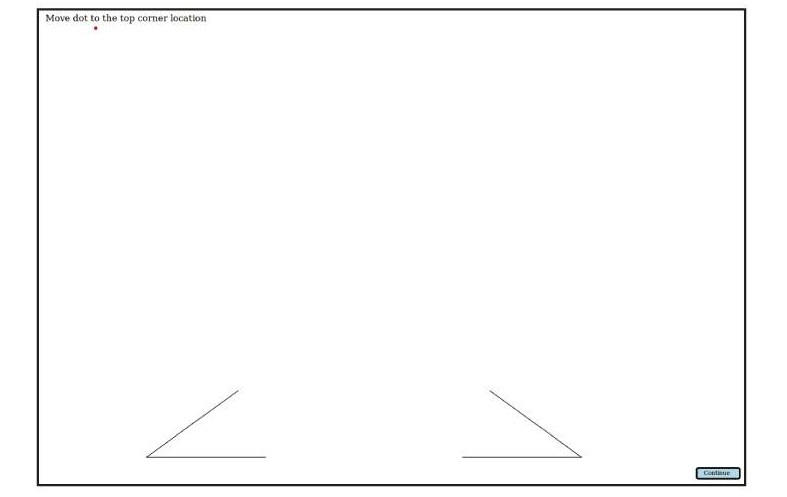 Subjects had to click where the 3rd corner of the triangle would be if the lines were extended upwards.
 They discovered that the estimated point by the subjects was systematically biased towards being below the actual convergence point, and the bias increased as the side length increased. (the estimate of the corner was lower than it should be).
 The standard deviation of errors increased sub linearly as length increased.
The results showed that the error increased with side length as expected, the further away the convergence point is, the more errors are expected. The experimenters then looked at the distribution of errors. They discovered that the estimated point by the subjects was systematically biased towards being below the actual convergence point. Also, the standard deviations of the error increased sub linearly with side length. That means the error did not increase at a constant rate, the rate of error actually decreased. The errors got bigger overall, but the rate of change decreased.
A model in which the subject extrapolates the convergence point with straight lines based on Euclidean geometry, would imply that the errors would not be biased in any direction, the standard deviations of the error should increase linearly or super linearly, but not be sub linear. And there should be no bias in any direction for how high the estimate convergence point is. But the experiments showed that subjects were biased towards placing the converge point closer to the base than where it actually was. For the x-axis placement, there was also a sub linear increase of error, but the error did not appear until large increases of side length (46x increase), and that errors were overall 4 times less than the y-axis errors.
They explained this difference by positing that our knowledge of Euclidean geometry is based on mental simulations of navigation, which approximate Euclidean geometry. And that this navigational skill is shared with other animals. This means that the concept of a straight line is not genetically programmed, but is learned based on a mental simulation of navigating through two locations. And that is learned through language. The same way we learn abstract concepts that we were not genetically programmed with through language such as the idea of checkmate.
They created a dynamic mathematical model to support this idea. It simulates the process of finding the convergence point through correlated random walks. A basic random walk is when you take a step either backwards or forwards, and repeat this process. This will result in you getting further away from the initial point on average as the amount of steps increases. It feels like you'd simply stay in the initial point on average, but actually you end up going further away on average. A correlated random walk takes into account past steps to keep the walk going in a certain direction.
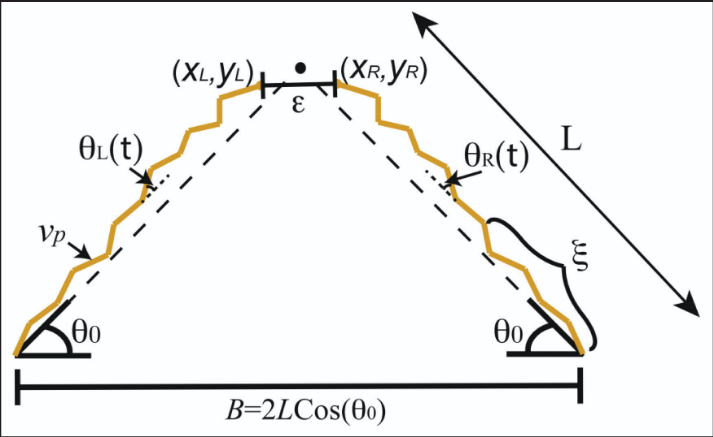 The model.
The process of moving from A to B is hypothesized to be made up of of small lines that are randomly oriented away for the base angle. A global error correction is needed to bring back lines which veer to far from the angle of the line. This model had four parameters. They simplified it to one, the correlated length by giving a statistical description of the dynamic model. The correlated length determines when a line path will be brought back to the base angle value, to stop it from veering out too far. This balances smooth continuation vs global angle. They suggested that the smooth continuation might be implemented by the curvature measurements of receptive fields. Keeping the angle consistent would be done through short-term visual memory.
The model also systematically biased the convergence point as being below the actual point. The convergence point would be found when the distance between the lines reached a certain value. The standard deviation of the error also increased sub linearly just like the subjects in the experiment. The model matched what actually happened in the experiment. The authors pointed out that such a model has an advantage of making less errors than a 'perfect' Euclidean geometry due to the random walk dynamic which makes the standard deviation of error reduce in rate as the triangle gets larger.
What this implies is that we learn geometrical concepts from noisy physical processes used in mental navigation.
This process is what ultimately leads to 'paradoxes' such as the Reti Puzzle.
You may also like
 RuyLopez1000
Bishop vs Knight Forever and Ever
The Bishop's Corner. ChessMonitor_Stats
Where do Grandmasters play Chess? - Lichess vs. Chess.com
This is the first large-scale analysis of Grandmaster activity across Chess.com and Lichess from 200… FM MathiCasa
Chess Football: A Fun and Creative Variant
Where chess pieces become "players" and the traditional chessboard turns into a soccer field CM HGabor
How titled players lie to you
This post is a word of warning for the average club player. As the chess world is becoming increasin… RuyLopez1000
Rook vs Rook + Bishop Endgame Tutorial
It is a technically drawn endgame that is practically difficult to play thibault